
Aiko vs LONGi for a UK roof: Neostar 3 or Hi-MO X10?
Two back-contact panels lead the efficiency tables on UK quotes in 2026: Aiko's Neostar 3 and LONGi's Hi-MO X10. We fit both, at the same £1,000 per kWp installed, so this guide sets the datasheets side by side and says where each one wins. The gap is smaller than either brand's marketing suggests, and on an Aiko quote the series code matters more than the badge.
Updated 29 October 2026 · written by the Clearline guidance team · 10 min read
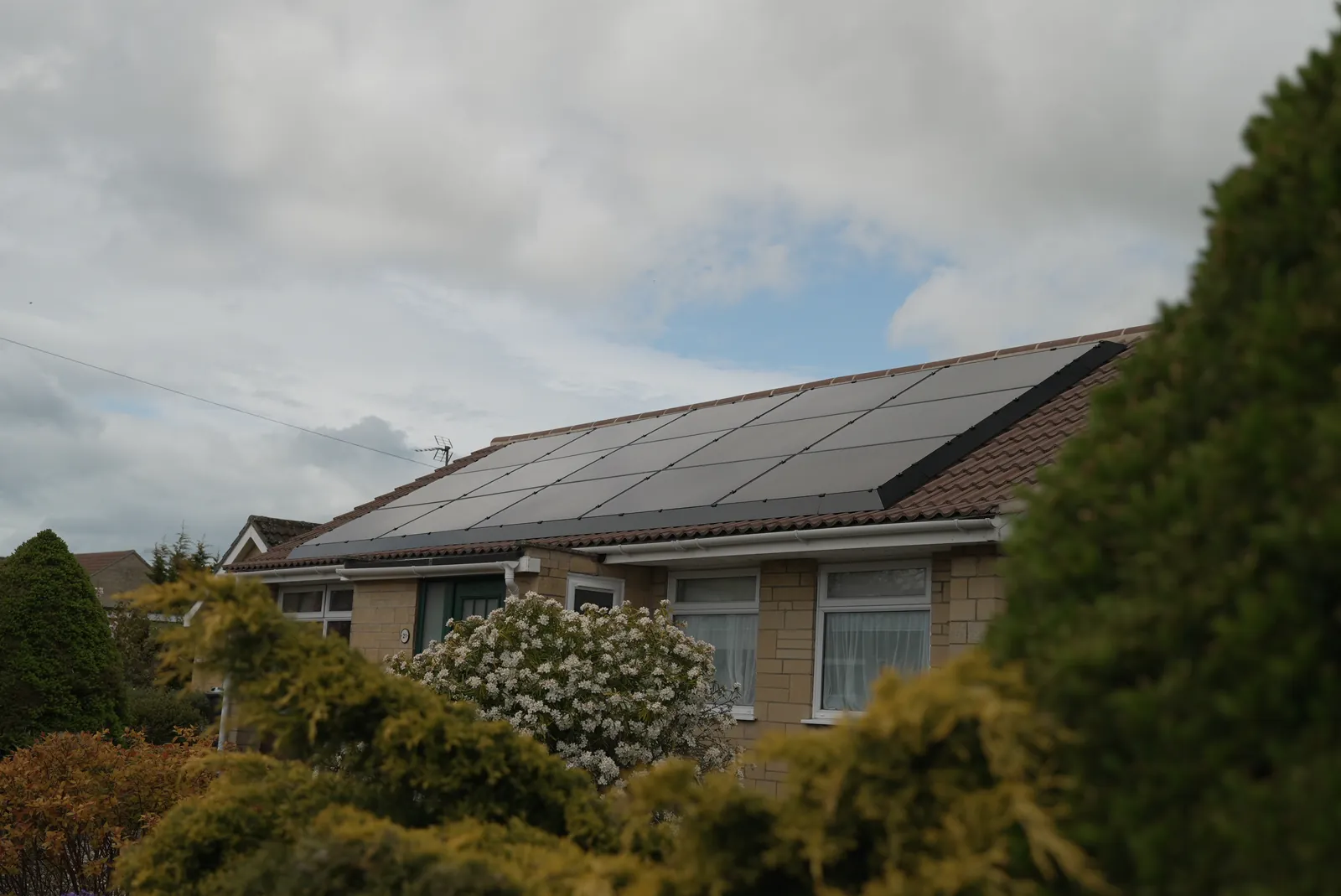
Choose the Aiko Neostar 3 when roof space is the limit, and the LONGi Hi-MO X10 when it is not. Aiko is the more efficient panel, at 24.3 per cent for the 485 W and 24.1 per cent for the 535 W against 23.5 per cent for the LONGi 530 W, and the 485 W is the shortest of the three, which helps on a short or split roof. On a large, clear roof that efficiency gap is worth about 0.6 square metres on a 5 kWp array, and both are £1,000 per kWp installed, so the product warranty decides. Both carry the same 30 year output guarantee, and the product warranty is where they differ. We fit both, and this guide is written to be fair to both.
| Datasheet figure | Aiko 485 W (A485-MCE54Mw) | Aiko 535 W (A535-MCE60Db) | LONGi Hi-MO X10 530 W |
|---|---|---|---|
Module efficiency | 24.3 per cent | 24.1 per cent | 23.5 per cent |
Size | 1762 x 1134 x 30 mm | 1954 x 1134 x 30 mm | 1990 x 1134 x 30 mm |
Weight | 21.1 kg | 27.1 kg | 28.5 kg |
Glass | Single, 3.2 mm | Dual, 2.0 + 2.0 mm, bifacial | Dual glass, bifacial |
Temperature coefficient of Pmax | minus 0.26 per cent per degree | minus 0.26 per cent per degree | minus 0.26 per cent per degree |
Fire class (IEC) | Class C | Class A | Not confirmed, so we quote none |
Product warranty | 15 years, extendable by Aiko to 20 or 25 (3P54 series) | 25 years (3S+60 series) | 15 years signed; 25 years on LONGi's UK and Ireland datasheet |
Performance warranty | 30 years, at least 88.85 per cent at year 30 | 30 years, at least 88.85 per cent at year 30 | 30 years, at least 88.85 per cent at year 30 |
Installed price | £1,000 per kWp installed | £1,000 per kWp installed | £1,000 per kWp installed |
All figures at standard test conditions. Aiko from datasheets revision 202608 V1.1, read 29 October 2026; LONGi from the Hi-MO X10 datasheet (UK and Ireland revision NU V01 20250603) and signed Limited Warranty, as on our LONGi page. The same Aiko wattage comes in other series with different glass, weight, fire class and product warranty, shown in the warranty table below; your written quote names the exact code.
Which suits your roof, Aiko or LONGi?
- Short, split or busy roof: the Aiko 485 W. At 1762 mm it is 228 mm shorter than the LONGi, so two portrait rows need about 3.5 metres of rafter run against about 4.0 metres, before edge clearance.
- Roof space is the limit: either Aiko panel. They need about 4.1 square metres of panel per kW, against about 4.3 for the LONGi, worked out from the datasheet sizes.
- Large, clear, simple roof: the LONGi or the Aiko 535 W, which are close on size, weight and glass. Both are £1,000 per kWp installed, so the look and the product warranty decide it.
- Longest product warranty wanted: the Aiko all-black S series, at 25 or 30 years depending on the size, against 15 years on the signed LONGi warranty. The Aiko P series is 15 years.
- Roof with real shade: neither panel replaces a shading design. Both makers claim an advantage in partial shade, and the evidence is covered below.
How much roof does each panel need?
Module efficiency is the share of the sunlight landing on a panel's face that becomes electricity under standard test conditions, so a higher figure means more watts from each square metre. This is what it looks like with ten panels of each.
| Ten panels of each | System size | Panel area | Two portrait rows |
|---|---|---|---|
Aiko 485 W | 4.85 kWp | about 20.0 square metres | about 3.5 m |
Aiko 535 W | 5.35 kWp | about 22.2 square metres | about 3.9 m |
LONGi 530 W | 5.30 kWp | about 22.6 square metres | about 4.0 m |
Arithmetic from the datasheet dimensions. Panel area only, before gaps, edge clearance, obstructions and the survey.
The efficiency gap between the Aiko 535 W and the LONGi, 24.1 against 23.5 per cent, works out at about 0.12 square metres per kW, or roughly 0.6 square metres on a 5 kWp array. That is real and it is small. It matters when a roof is a panel or two short, and not otherwise. On a tight roof the length of the panel matters more than its efficiency, which is why the 485 W stands out. Weight is the other practical difference: at 21.1 kg the single glass 485 W is the lighter panel to carry up a scaffold, while the two dual glass panels are within 1.4 kg of each other. Our guide to how many solar panels fit your roof shows how to count them.

Is the Aiko or LONGi warranty better?
The output guarantee is identical. Both promise at least 99 per cent of rated power in year one, a decline of no more than 0.35 per cent a year after that, and at least 88.85 per cent at year 30, for the front of the panel only. The product warranty, which covers the panel itself, is where the two differ, and with Aiko it varies by series rather than by wattage.
| Panel | Series | Product warranty |
|---|---|---|
Aiko 485 W | 3S54 and 3S+54 (all black) | 30 years |
Aiko 485 W | 3P54 and 3P+54 (black frame) | 15 years, extendable by Aiko to 20 or 25 |
Aiko 535 W | 3S60 and 3S+60 (all black) | 25 years |
Aiko 535 W | 3P60 and 3P+60 (black frame) | 15 years, extendable by Aiko to 20 or 25 |
LONGi Hi-MO X10 530 W | LR7-60HVD-530M | 15 years under the signed LONGi Limited Warranty; 25 years on LONGi's UK and Ireland datasheet |
Aiko terms from its Residential Modules (v1.8) and Full-black Gen-3 Infinite Modules (v1.2) warranty documents and its product pages, read 29 October 2026. The extension is paid, and Aiko decides project by project whether to grant it.
Aiko's current documents give 30 years for the all-black 54-cell series at 480 W and above, although some UK trade pages still show 25. That is why your written quote names the exact model code and the warranty document, rather than quoting one number for the Aiko 485 W.
Read what each warranty pays for, not only how long it runs. Aiko's terms let it choose between repair, replacement and a refund of residual value, leave removal and refitting costs with the owner, and ask for claims in writing within 30 days of spotting a fault, with serial numbers. The warrantor is Zhejiang AIKO Solar Technology Co., Ltd. in China, and claims go through Aiko or its authorised distributors. Check the labour wording in whichever panel warranty is on your quote: our best solar panels guide explains why REC's, which covers labour, is the exception. A warranty that runs into the 2050s is also only as good as the company still standing behind it, which is true of both brands.
Get my free quote
Three details. We call or text within one working day to book your free 30-minute design call, on video or by phone if you prefer.
Do Aiko or LONGi panels cope better with shade?
Both are back-contact designs, and both makers say their panels lose less power than TOPCon in partial shade. Every figure below is a maker's own test unless it says otherwise, and none of them measures one brand against the other.
- Aiko's own test: in a flash test by TÜV Nord that Aiko cites, with a single cell masked, an Aiko panel kept about 95 per cent of its power under light cover and about 70 per cent under full cover, against about 90 and about 40 per cent for the TOPCon panel beside it.
- LONGi's own figures: power loss under partial shade up to 70 per cent lower than a TOPCon panel, with hot-spot temperature down by as much as 28 per cent. These are the figures on our LONGi page, and they are LONGi's.
- The one independent test we found was run by a Brisbane electrical and solar firm, with nine Aiko 465 W panels on one string and nine Canadian Solar 465 W panels on another. Moderate shade and a third of a panel covered made no difference. Under a very small shadow the Canadian Solar side lost about 150 W against about 50 W for Aiko. Over several weeks Aiko averaged about 0.9 per cent ahead, or about 0.2 per cent once its positive power tolerance was allowed for. The firm concluded Aiko's shade claims are overstated. It is a single small test, and Aiko disputes it.
Each maker compares itself with a TOPCon reference of its own choosing, so the numbers cannot be set side by side, and we have not found an independent test that puts an Aiko panel next to a LONGi. Our reading is that a back-contact design may help with small, hard shadows such as a vent pipe or an aerial, as the one independent test suggests, and that none of it fixes a roof shaded for much of the day. That is solved in the design: see microinverters, optimisers and string inverters, and our back contact guide for the technology behind both claims.
What does an Aiko or LONGi system cost?
Both are £1,000 per kWp installed, so the price follows the size of the system, not the badge. Ten LONGi 530 W panels at 5.30 kWp are £5,300, ten Aiko 485 W panels at 4.85 kWp are £4,850 and ten Aiko 535 W panels at 5.35 kWp are £5,350, all installed before any battery and subject to survey. An Aiko quote names the exact model code and its warranty in writing. Per-panel prices you may see online are trade prices for the bare module, not an installed price. The number to compare between quotes is the installed price per kWp with the product warranty beside it. Our LONGi page has the calculator, and the Aiko page covers the series and model codes.
What about Jinko, JA Solar, REC and Trina?
Other firms may quote you panels from these four makers. The table sets their datasheet figures beside the two panels in this guide, using the numbers in our best solar panels guide.
| Panel | Module efficiency | Product warranty | Performance warranty |
|---|---|---|---|
Aiko Neostar 3 (485 W and 535 W) | 24.3 and 24.1 per cent | 15, 25 or 30 years by series | 30 years, 88.85 per cent at year 30 |
LONGi Hi-MO X10 530 W | 23.5 per cent | 15 years signed; 25 on the UK and Ireland datasheet | 30 years, 88.85 per cent at year 30 |
REC Alpha Pure RX | 22.6 per cent | Up to 25 years with ProTrust | 25 years, 92 per cent retained |
Jinko Tiger Neo | 22.02 per cent (440W all-black) | 15 years on the cited datasheet | 30 years linear, 0.4 per cent a year after year one |
Trina Vertex S+ | 22.5 per cent at 450W (23.0 per cent maximum on the range) | Up to 25 years | 30 years |
JA Solar DeepBlue 4.0 | 22.8 per cent | 25 years | 30 years, 87.4 per cent at year 30 |
Figures from manufacturer and UK distributor pages, read 27 and 28 August 2026 (Aiko and LONGi as above). Different wattage bins are compared, so treat the gaps as a guide. The datasheet for the exact model on your quote governs.
On these figures the two back-contact panels lead on efficiency by between 0.7 and 2.3 percentage points. REC is the standout on warranty, because ProTrust covers labour as well as the panel when the system is fitted by an REC-certified installation team. Jinko's Tiger Neo has a 15 year product warranty on the datasheet we cite, the same as the Aiko P series and the signed LONGi warranty, and JA Solar's output guarantee ends at 87.4 per cent against 88.85 for Aiko and LONGi. The full reading of each is in our best solar panels guide, and solar panel types explained covers the cell technologies.
How we would choose between them
Start with the roof, not the badge
Measure the rafter run, count the obstructions and note the shading. Panel length and area decide which panels fit, and the design call works from those.
Decide what is limiting you
If it is roof space, the Aiko panels have the edge. If it is budget, both cost £1,000 per kWp installed, so the product warranty on the series quoted decides it.
Read the series code
For Aiko, the letters after the wattage (3S, 3S+, 3P, 3P+) set the glass, the look and the product warranty. Ask for the code and the warranty document in writing.
Ask for the shade design
A claim about shade is not a design. Ask how the strings are laid out and whether any panel needs an optimiser.
A free 30-minute design call takes your roof dimensions, shading and electricity use and prices the panel that suits them. It is a video call with one of our residential energy consultants (phone if you prefer), not a home visit, and there is no obligation. An Aiko quote names the exact model code and its warranty in writing, and both brands are £1,000 per kWp installed.
Get my free quote →Aiko vs LONGi, answered
Which is better, Aiko or LONGi?
Neither wins everywhere. Aiko's Neostar 3 is more efficient, at 24.3 and 24.1 per cent against 23.5 per cent, and the 485 W is the shortest panel of the three, so it suits tight or split roofs. Both are £1,000 per kWp installed with us, and LONGi's output guarantee matches Aiko's. On a large, clear roof the decision comes down to the look and the product warranty on your quote.
Is LONGi a Tier 1 solar panel?
We cannot confirm it from a public source. Tier 1 is BloombergNEF's bankability classification for large solar projects, not a quality rating, and the list is subscriber-only, so there is no public page to check. Any brand that says it is on the list, Aiko included, is making its own claim. What you can verify yourself is the exact model's datasheet, its MCS product certificate and the warranty document named on your quote.
Which solar panel brand is better, Jinko or Aiko?
On the datasheets, Aiko leads on efficiency, at 24.3 and 24.1 per cent against 22.02 per cent for Jinko's Tiger Neo 440W all-black, and on temperature coefficient, minus 0.26 against minus 0.29 per cent per degree. Jinko's Tiger Neo is a TOPCon panel, the mainstream route on price per watt, with a 15 year product warranty on the datasheet we cite. Compare the installed price per kWp, not the badge.
What is the most reliable solar panel brand?
No single ranking settles it. Independent test programmes such as Kiwa PVEL publish results by model, and a badge belongs to that model alone: Aiko's 2026 Top Performer listing, for example, is for a large-format module, not the Neostar 3 panels in this guide. For your roof, a named warranty document and an MCS-certified installation, which is what makes any warranty enforceable, tell you more than a brand league table.
Can I mix Aiko and LONGi panels on one roof?
Technically yes, but it needs care. Panels with different electrical characteristics should not share one string, because the weakest panel sets the current for the rest. Different panels can sit on separate strings or inverter inputs, as the two faces of an east and west roof already do. Different series also bring different warranties and paperwork, so mixing is a design decision for your design call.
Which handles shade better, Aiko or LONGi?
The evidence cannot say. Each maker publishes its own test against a TOPCon reference of its choosing, and we have found no independent test that sets Aiko against LONGi. The one independent test we found, a Brisbane firm comparing Aiko with a TOPCon panel, showed a small gain, mostly under very small shadows. On a shaded roof the string design matters more than the brand, and we plan that on the call.
See the numbers next: LONGi 530 W panels, installed, or the solar panels guide.
Aiko figures are from AIKO's datasheets (revision 202608 V1.1) and warranty documents, read 29 October 2026. LONGi figures are from the datasheet and signed warranty cited on our LONGi page, read 20 August 2026. The comparison with Jinko, JA Solar, REC and Trina reuses the datasheet figures and sources from our best solar panels guide, read 27 and 28 August 2026. BloombergNEF's Tier 1 list is subscriber-only, so we have not verified any brand's place on it. Shade and hot-spot figures are the makers' own tests unless stated. Warranty terms vary by series and market; the datasheet and warranty document for the exact model code on your quote govern. Aiko, Neostar, LONGi and Hi-MO are trademarks of their respective owners.
Sources
- AIKO Neostar 3P54 datasheet, AIKO-A-MCE54Mw 470-500W, revision 202608 V1.1: 485 W bin, 24.3% module efficiency, 1762 x 1134 x 30 mm, 21.1 kg, 3.2 mm single glass, minus 0.26%/C, IEC Class C, N-type ABC cells https://aikosolar.com/wp-content/uploads/2026/10/Neostar-3P54_193-AIKO-A-MCE54Mw_470-500W-1762%C3%971134%C3%9730_202608_V1_1_EN.pdf
- AIKO Neostar 3S+60 datasheet, AIKO-A-MCE60Db 515-545W, revision 202608 V1.1: 535 W bin, 24.1% module efficiency, 1954 x 1134 x 30 mm, 27.1 kg, 2.0 + 2.0 mm dual glass, minus 0.26%/C, IEC Class A https://aikosolar.com/wp-content/uploads/2026/10/Neostar-3SPlus60_193-AIKO-A-MCE60Db_515-545W-1954x1134x30mm_202608_V1_1_EN.pdf
- AIKO Neostar 3P54 product page: 15 year product warranty extendable to 25 years, 30 year performance warranty https://aikosolar.com/en/products/neostar-3p54-mono-glass/
- AIKO Neostar 3S+60 product page: 25 year product warranty, 30 year performance warranty, at least 99% of rated power in year one and no more than 0.35% a year after https://aikosolar.com/en/products/neostar-3splus60-dual-glass/
- AIKO N-Type ABC Module Warranty, Residential Modules v1.8: 25 years product cover for the 60-cell all-black series, remedy at AIKO's choice, removal and reinstallation costs with the customer, written claims within 30 days https://aikosolar.com/wp-content/uploads/2026/10/WI-0BQM-M005-N-Type-ABC-Module-Warranty%EF%BC%88Residential-Modules%EF%BC%89-1.8-EN.pdf
- AIKO N-Type ABC Module Warranty, Full-black Gen-3 Infinite Modules v1.2: 30 years product cover for the all-black 54-cell series at 480 W and above https://aikosolar.com/wp-content/uploads/2026/10/WI-0BQM-M021-N-Type-ABC-Module-Warranty%EF%BC%88Full-black-Gen-3-Infinite-Modules%EF%BC%89-1.2-EN.pdf
- AIKO partial shading questions and answers: TÜV Nord flash test, single cell masked, AIKO about 95% power at light cover and about 70% at full cover against about 90% and about 40% for a TOPCon reference (AIKO's own cited test) https://aikosolar.com/au/partial-shading-q-and-a/
- Independent shade test by a Brisbane electrical and solar firm: nine AIKO 465W panels against nine Canadian Solar 465W panels on separate strings, no difference at moderate shade, about 150W lost against about 50W under a very small shadow, about 0.9% net advantage to AIKO, about 0.2% after power tolerance; concludes AIKO's shade claims are overstated https://mcelectrical.com.au/?p=9475
- Clearline LONGi 530 W page, citing the LONGi Hi-MO X10 datasheet LR7-60HVD 530~555M (UK and Ireland revision NU V01 20250603) and the LONGi Limited Warranty for Hi-MO X10, Distributed Generation Market, 2025.12: 23.5% module efficiency, 1990 x 1134 x 30 mm, 28.5 kg, minus 0.260%/C, 15 year signed product warranty, 25 years on the UK and Ireland datasheet, 30 year performance warranty to at least 88.85%, £1,000 per kWp installed, and LONGi's own shading figures https://clearlinehomeenergy.co.uk/solar-panels/longi
- Jinko Solar EU datasheet, Tiger Neo JKM420-440N-54HL4R-BDV all-black dual glass: module efficiency 22.02% at 440W, 15 year product warranty, 30 year linear power warranty with 0.4% annual degradation, temperature coefficient -0.29%/C https://jinkosolar.eu/wp-content/uploads/JKM420-440N-54HL4R-BDV-F1.2-EN-4.pdf
- REC Group, Alpha Pure RX product page: HJT cells, 22.6% efficiency, ProTrust warranty up to 25 years product, performance and labour with 92% output at year 25 when fitted by an REC-certified installation team https://www.recgroup.com/en-us/rec-alpha-pure-rx
- Trina Solar, Vertex S+ TSM-NEG9R.28 datasheet: power range 430 to 460W, maximum efficiency 23.0%, up to 25 years product and 30 years power warranty https://static.trinasolar.com/sites/default/files/Datasheet_Vertex%20S+_NEG9R.28_EN_2024_C_web.pdf
- Trina Solar Vertex S+ 450W UK listing: 22.5% efficiency, 25 year product and 30 year power warranty https://www.alternergy.co.uk/shop/tsm-450-neg9r-28-trina-solar-450w-vertex-s-n-type-topcon-monofacial-dual-glass-black-frame-2349
- JA Solar official product page, DeepBlue 4.0 Pro JAM54D40 MB BF: 420 to 445W, 22.8% module efficiency, N-type TOPCon bifacial double glass https://www.jasolar.eu/en/products/jam54d40-mb-bf
- Spectrum Energy Systems, JA Solar vs Aiko vs LONGi comparison: JA Solar DeepBlue 4.0 25 year product and 30 year performance warranty to 87.4% https://spectrumenergysystems.co.uk/articles/ja-solar-vs-aiko-vs-longi-comparison/
- Kiwa PVEL 2026 Top Performer recognition for AIKO, awarded on the AIKO GRH66Dw large-format module, not the Neostar https://www.pv-tech.org/industry-updates/aiko-recognized-as-kiwa-pvel-2026-top-performer/
Read next
Best solar panels UK 2026: what the datasheets actually say
One pick per job, the specs behind each, and what moves payback more than the badge.
Read the guide →Do solar panels need direct sunlight? Not really, and here is why
No. Solar cells respond to light hitting them, not to a clear line of sight to the sun.
Read the guide →AC coupled or DC coupled? The 60 second answer
AC for retrofits, DC for new installs. The reasoning, the efficiency gap and when the rule flips.
Read the guide →