
LONGi 530 W bifacial solar panels on a UK roof
The Hi-MO X10 puts 530 watts into 2.26 square metres, at 23.5 per cent module efficiency, behind glass on both faces. Here is what that means on a British roof, what it costs, and which of its selling points actually apply to a pitched tile roof.
from £1,000 per kWp installed
Per kilowatt peak, installed. Subject to survey.


What would a LONGi array do for your bills?
Move the sliders. Nothing is sent anywhere and no email is needed to see the number.
LONGi Hi-MO X10 530 W
Your real roof, your real usage, on a free video call. No obligation, and no home visit needed.
Are LONGi panels any good?
Yes. LONGi is the largest solar module manufacturer in the world, and this one carries a 30-year performance warranty with output guaranteed not to fall below 88.85 per cent of rated power by year thirty.
The Hi-MO X10 is the current generation, using LONGi's HPBC 2.0 cell with the contacts moved to the back of the cell. That is what gets 530 watts out of a panel measuring 1990 by 1134 mm, at 23.5 per cent module efficiency at standard test conditions.
The temperature coefficient is worth a mention because British weather is where it pays. At minus 0.260 per cent per degree, output falls more slowly on a hot roof than older panel designs manage. On a mild, bright UK day that works in your favour.

The Hi-MO X10 launch film, from LONGi Solar Europe.
What bifacial adds, and where it adds it
A bifacial panel has glass on both faces and can generate from light hitting the back as well as the front. That only pays when light can get behind the panel and there is something bright below to bounce it back up. On a standard pitched roof neither is really true: the panels sit around 100 to 150 mm off the tiles, and slate and concrete tile are dark. The extra generation on a typical domestic pitched roof is small, and LONGi does not guarantee it. Their 30-year performance warranty covers the front of the panel only. Bifacial earns its keep on ground mounts over pale gravel, on flat roofs with a white membrane, and on elevated frames. Those are not most houses. The real reasons to fit this panel on a home are the dual-glass build, which is more durable than a plastic-backed panel and is why it carries a 30-year performance warranty, and the HPBC 2.0 cell, which is what gets 530 W out of 2.26 square metres. Treat any rear-side gain as a bonus, never as part of your payback.
Two wattages, and which one is yours
Bifacial panels are often advertised with two figures. The larger one assumes a set amount of light reaching the back, and the reference condition behind it puts the panel a metre above light-coloured soil at a 37 degree tilt. That is a field, not a roof. If you are quoted a higher wattage for a bifacial panel, it is worth asking which figure it is. The 530 W here is the front-side figure at standard test conditions, which is the honest one to plan a roof around, and it is the number every estimate on this site uses.
What your MCS estimate will be based on
Every MCS-registered installer has to give you a performance estimate calculated the same way: system size in kWp, times a regional sunlight figure, times a shading factor. We read the current MCS documents to check. The word "bifacial" does not appear in MCS 032:2025, in MIS 3002, or in the MCS installation guide, and neither does any term for rear-side gain or albedo. So the number on your MCS estimate is a front-side number whichever panel you buy. If anyone quotes you a higher figure because the panels are bifacial, they have stepped outside the MCS method to do it.
MCS 032:2025 Issue 1.0 and MIS 3002:2025, read 20 August 2026.
Shade and short winter days
Shading, one cell at a time
The HPBC 2.0 back-contact design bypasses shaded cells individually rather than losing a whole string to one chimney shadow or a scaffold pole. LONGi’s own figures put power loss under partial shade at up to 70 per cent lower than a TOPCon panel, with hotspot temperature down by as much as 28 per cent.

How the shading bypass works, from LONGi Solar Australia.
Low light and long winters
This is the one official LONGi film that shows the Hi-MO X10 on an ordinary home roof through a real northern European winter, not a lab test. It is the practical case for the temperature coefficient already covered above: a panel that keeps producing when the light is thin, which describes most UK days from October to March.
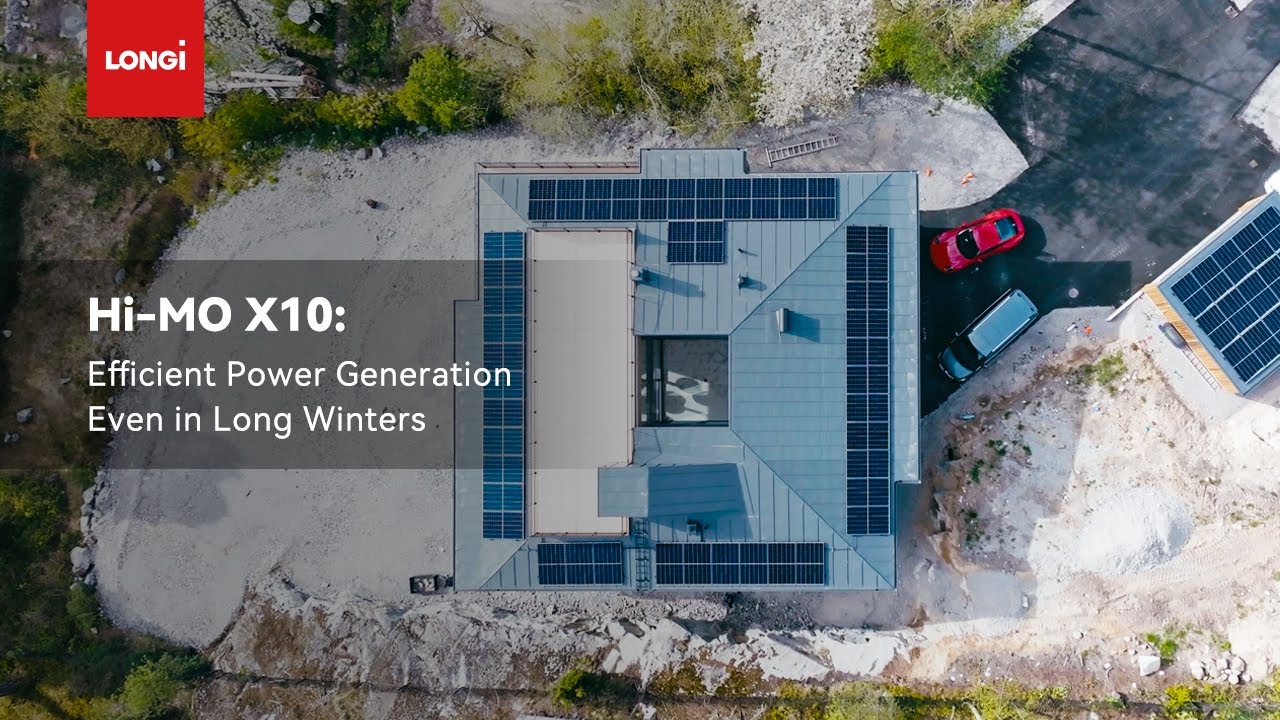
The Hi-MO X10 through a real northern winter, from LONGi Solar.
What LONGi panels cost, and how many fit
Solar is priced at £1,000 per kWp installed. Ten of these panels is 5.30 kWp, so £5,300 installed.
Roof space is the constraint people underestimate. Each panel takes about 2.26 square metres, so ten of them need roughly 23 square metres of clear roof plus space around the edges.
This is a physically large panel. At 1990 mm tall, two rows in portrait need about four metres of rafter length before you allow any edge clearance, closer to 4.6 metres with it. Plenty of UK semi-detached rear roofs are right on that boundary, so a ten-panel array sometimes needs splitting across two roof faces or laying out in landscape. That is exactly what the survey is for, and it is why we would rather say "subject to survey" than imply ten panels drop onto any house.
The two packages that pair with it
Thirty years of guaranteed output
Thirty years on output
The performance warranty runs a full 30 years and is the one that protects what the panels actually earn you. Alongside it, a 15-year product warranty covers the panel itself, materials and workmanship. Both come with the modules. LONGi's UK and Ireland market datasheet (revision NU V01, June 2025) shows a 25-year product warranty for this market; we publish the 15-year term from the signed LONGi Limited Warranty until the UK document is in hand, and your written quote states the exact term that applies to your installation.
What the output guarantee says
At least 99 per cent of rated power in year one, then no more than 0.35 per cent decline a year, leaving at least 88.85 per cent at year thirty. On a 530 W panel that is still around 471 W after three decades.
What it does not cover
The performance warranty applies to the front of the panel only, which is the honest answer to the bifacial question above. It also guarantees output, not savings: LONGi excludes loss of income or profit, as manufacturers generally do.
Warranty terms from LONGi's UK and Ireland datasheet for the LR7-60HVD range, revision NU V01 20250603, and the LONGi Limited Warranty for Hi-MO X10 modules, December 2025. The installation team for your area hands you the warranty document with the rest of the paperwork.
MCS, and why it matters for your export payments
To be paid under the Smart Export Guarantee, a supplier asks for an MCS installation certificate. An MCS-registered installer can only issue one for modules that are on the MCS product directory at the time of installation, so directory listing is a precondition and installer certification is the thing you actually receive.
Your MCS installation certificate, which export tariffs ask for, is issued against the exact modules fitted. The current MCS product certificate for the panel specified is confirmed for you before install day, and the certificate number goes on your paperwork. Our guide to the Smart Export Guarantee explains what to do with the certificate once you have it.
MCS 005 Issue 4.0 became mandatory on 1 August 2026 with a grace period running to 1 February 2027, and a number of older modules across the industry drop off the directory at that point. The installation team for your area confirms the specific model on your certificate.
Full specification
| Rated power | 530 W |
|---|---|
| Module efficiency | 23.5 per cent at standard test conditions |
| Cell technology | HPBC 2.0, n-type wafer, busbar-free |
| Cells | 120 half-cut, from 60 full cells |
| Construction | Dual glass, bifacial |
| Bifaciality factor | 70 per cent, plus or minus 5 |
| Dimensions | 1990 x 1134 x 30 mm |
| Area per panel | 2.26 square metres |
| Weight | 28.5 kg |
| Frame | Black anodised aluminium |
| Voc and Isc | 44.95 V and 14.90 A |
| Power at NOCT | 403 W |
| Temperature coefficient of Pmax | minus 0.260 per cent per C |
| Power tolerance | 0 to plus 3 per cent |
| Operating temperature | minus 40 to 85 C |
| Mechanical load | 5400 Pa front, 2400 Pa rear |
| Junction box | IP68, three diodes |
| Certification | IEC 61215 and IEC 61730 |
| Product warranty | 15 years under the signed LONGi Limited Warranty; LONGi's UK and Ireland datasheet shows 25 years for this market |
| Performance warranty | 30 years, front side only |
| Year one output | At least 99 per cent of rated power |
| Annual degradation, years 2 to 30 | No more than 0.35 per cent |
| Output retained at year 30 | At least 88.85 per cent |
Source: LONGi Hi-MO X10 datasheet LR7-60HVD 530~555M, UK and Ireland revision NU V01 20250603, and the LONGi Limited Warranty for Hi-MO X10, Distributed Generation Market, 2025.12, model LR7-60HVD-530M, read 2026-08-20.
Every installation is carried out by teams holding:



Guides on this topic
Sourced, dated, and written to be read before anyone quotes you.
Are solar panels worth it in 2026? Here is the actual maths
Roughly £1,000 per kWp installed, offsetting electricity at 26.32p a unit. The real arithmetic.
Read the guide →Best solar panels UK 2026: what the datasheets actually say
One pick per job, the specs behind each, and what moves payback more than the badge.
Read the guide →DNO application timescales, network by network: from a G98 notification to a G99 approval
Fit and notify within 28 days, or wait ten working days to 45 for a yes. System size decides which.
Read the guide →Do solar panels increase home value? What the actual data shows
The largest UK study found a 6.1% to 7.1% sale price premium. Here is the full picture.
Read the guide →Do solar panels need direct sunlight? Not really, and here is why
No. Solar cells respond to light hitting them, not to a clear line of sight to the sun.
Read the guide →Do solar panels work in winter? Yes, just less than summer
Panels run on light, not sunshine. Cloud turns them down, not off. What that means for an awkward roof.
Read the guide →LONGi 530 W questions, answered
Are LONGi solar panels any good?
Yes. LONGi is the world’s largest solar module manufacturer, and the Hi-MO X10 530 W carries a 30-year performance warranty guaranteeing at least 88.85 per cent of rated output at year thirty. It reaches 23.5 per cent module efficiency at standard test conditions.
What does bifacial mean, and is it worth it on my roof?
A bifacial panel has glass on both faces and can generate from light hitting the back. On a standard pitched tile roof very little light reaches the back, and what does lands on dark tiles, so the gain is small. LONGi warrants front-side output only. The real benefits on a house are the dual-glass build and the 30-year performance warranty, not rear-side generation.
How many 530 W panels do I need?
Ten panels give you 5.3 kWp, which is a common size for a family home. Each panel needs about 2.26 square metres, so ten need roughly 23 square metres of clear roof plus edge clearances. Whether that fits depends on your roof, and this is a large panel at 1990 mm tall.
What is the warranty on LONGi panels?
Thirty years on performance and 15 years on the product. The performance warranty guarantees at least 99 per cent of rated output in year one, declining no more than 0.35 per cent a year, and at least 88.85 per cent still there at year thirty. The product warranty covers the panel itself, its materials and workmanship.
Where are LONGi panels made?
LONGi Green Energy Technology is headquartered in China and manufactures at sites across several countries. It is the largest module manufacturer in the world by volume. For the UK market the modules reach installation teams through LONGi’s listed distributors rather than directly.
Are LONGi panels MCS certified?
Your MCS installation certificate, which export tariffs ask for, is issued against the exact modules fitted, and an MCS-registered installer can only issue one for modules that are on the MCS product directory at the time of installation. The current MCS product certificate for the panel specified is confirmed for you before install day, and the certificate number goes on your paperwork.
How do LONGi panels compare with Aiko or Jinko?
Aiko’s current cells reach a higher module efficiency, which matters most when roof space is tight and you need maximum output from a small area. Jinko and LONGi are closer to each other. For most UK roofs the more useful comparison is installed cost per kWp and the warranty behind it rather than a percentage point of efficiency, and that is a conversation for your design call.
Get your free quote
Takes about two minutes. We work out your options, then confirm your free remote design call, on video, at a time that suits you. It starts with your roof and your numbers, and the design is built around them rather than around a product someone needs to shift.