
Home › Coverage › Warwickshire › Birmingham
WarwickshireSolar panels in Birmingham,
priced honestly.
Independent guidance on solar and battery storage for Birmingham homes in Warwickshire: a free remote design call first, then an MCS-certified installation team for your area if you decide to go ahead. PVGIS puts a roof in Birmingham at 968 kWh per kWp a year, 3% below our Warwickshire county estimate.
Start with your postcode
Free, no obligation. Takes about two minutes, and nobody visits your home.
What a roof in Birmingham can generate
Real satellite data for Birmingham, real installed pricing, and the same honest model we run for every place we cover.
How Birmingham compares
Birmingham is one of 19 Warwickshire towns we track, and it ranks joint 18th of 19 for solar yield. The House of Commons Library settlement classification puts it in the core city class, with a population of 1,159,936, which makes it one of the largest places we publish figures for. Scale changes nothing about the physics: PVGIS gives a roof here 968 kWh per kWp a year, 2.65 peak sun hours a day averaged across the seasons, and on the 12p scenario about £247 of the year one benefit comes from solar you use yourself, with export income adding £626.
Treat these as calibration rather than a quote. The calculator below runs the same model, defaulted to Birmingham's own yield, and at Birmingham's 968 kWh per kWp it prices a 12 panel system at £6,360 installed before any battery. Your free design call reworks every number for your actual roof, its shading and your usage.
Birmingham is the planning authority covering Birmingham, which the House of Commons Library classes as a core city.
The charger is in the installed price but left out of payback: charging savings depend on your mileage and tariff, which the design call models properly.
Price this properly, free →Your real roof, your real usage, on a free video call. No obligation.
A 12 panel, 6.36 kWp system in Birmingham generates around 6,156 kWh a year, worth around £873 in year one on the 12p export scenario.
Generation is modelled from PVGIS satellite data for Birmingham's own coordinates (52.4686, -1.87923), using the same 26.32p/kWh import value and £1,000 per kWp installed pricing as every Clearline estimate, with the full methodology, sourcing and assumptions set out on our help page.
Local detail for Birmingham
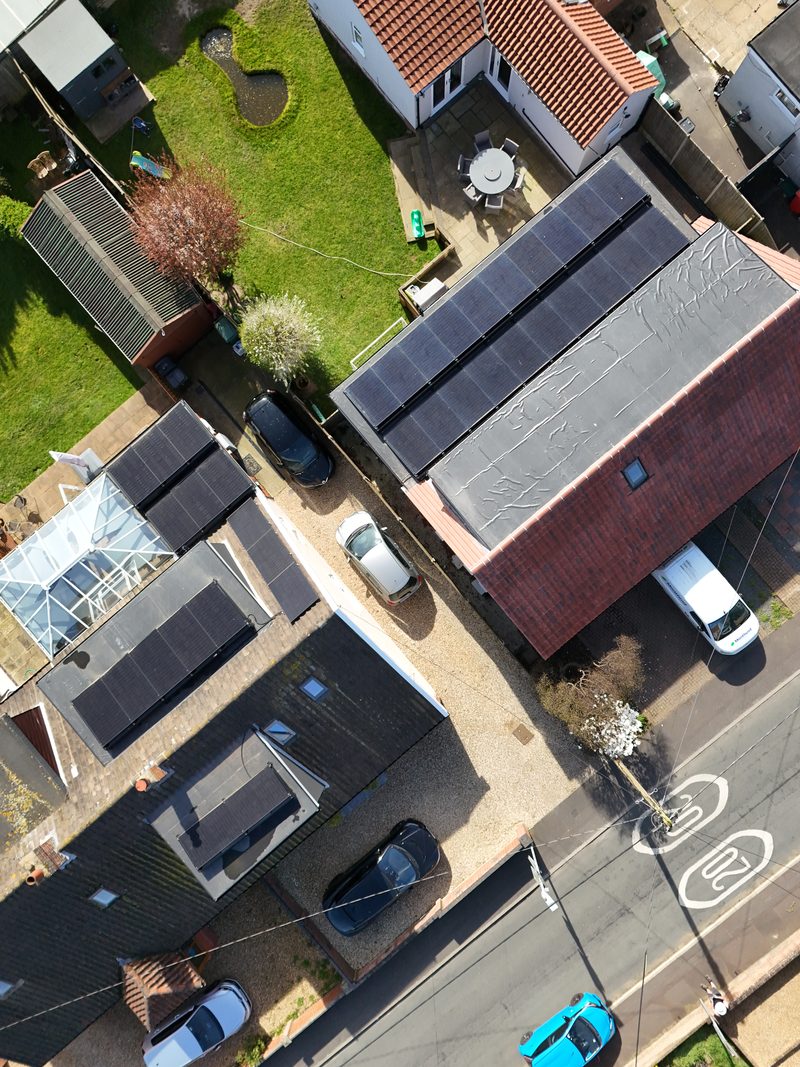
Birmingham's housing spans several distinct eras: dense back-to-back terraced courts from nineteenth-century industrial expansion, almost all demolished by the early 1970s bar one preserved court; large interwar council estates, one of which alone housed around 30,000 people; and garden-suburb developments such as Bournville, which today has around 7,800 homes with larger gardens. That range of housing eras means roof shape and available roof space vary considerably by neighbourhood.
Birmingham sits in National Grid Electricity Distribution territory, on its West Midlands licence. National Grid Electricity Distribution's own published Guaranteed Standard is 45 working days for a low voltage generation quotation, with a complete application acknowledged within 10 working days; most single home systems use the quicker 28-day G98 route instead. Birmingham City Council is the planning authority and lists 29 conservation areas across the city.
The council declared a Climate Emergency on 11 June 2019 and has set a target of net zero carbon by 2030, or as soon after that date as a genuinely just transition allows for the city. Its own Switch Together Birmingham scheme, run with iChoosr, already offers residents solar panels and home battery storage at a group-buying price, negotiated on behalf of everyone who signs up rather than house by house.
Network operator (DNO): National Grid Electricity Distribution · G99 application
Planning authority: Birmingham City Council
Solar panel servicing and repair in Birmingham
Faults, servicing and ageing inverters follow the same economics in Birmingham as anywhere else, and the guides below price them plainly.
Common questions about solar in Birmingham
What could a roof in Birmingham generate?
PVGIS puts a roof in Birmingham at 968 kWh per kWp a year, 2.65 peak sun hours a day averaged across the seasons.
What does a typical solar system cost in Birmingham?
A typical 12 panel, 6.36 kWp system in Birmingham costs around £6,360 installed, at £1,000 per kWp before any battery.
Would a system in Birmingham need a G99 application?
Most home solar and battery systems qualify for the simpler G98 notification, made to the network operator (DNO) after installation rather than before. A minority, usually larger systems, need the fuller G99 process instead. Your design call checks which applies in Birmingham before anything is booked; our G98 vs G99 guide explains the difference in full.
What could I earn from exporting in Birmingham?
On the 12p export scenario, that 12 panel system sends about 5,220 kWh a year to the grid, worth around £626. The tariff guide compares the export rates that could apply to your setup.
Get your free quote
Takes about two minutes. We work out your options, then confirm your free remote design call, on video, at a time that suits you. It starts with your roof and your numbers, and the design is built around them rather than around a product someone needs to shift.
Reading for Birmingham homeowners
Independent, sourced and dated. The same ground we cover on your free call.
0% VAT on solar and batteries: what qualifies, and what does not
Zero VAT until 31 March 2027, then 5% returns. What qualifies, and what it is worth.
Read the guide →What a battery gateway actually does
Without a gateway your system shuts down when the grid does. Here is what the box actually does.
Read the guide →What an EV charger installation actually involves
Main fuse, DNO notification, load balancing and the paperwork. What really happens.
Read the guide →Sizing a heat pump: what a proper survey covers
Sized by calculation, not by rule of thumb. What the survey covers, and what guessing costs.
Read the guide →Why tariff choice moves payback more than kit choice
Identical kit, five times the export income. The tariff decision worked through with August 2026 rates.
Read the guide →How to check an MCS certificate is genuine, before the deposit leaves your account
A logo proves nothing. Certification is business specific, technology specific and checkable.
Read the guide →How Birmingham compares with its neighbours
Same satellite dataset, same assumptions, so the differences are real geography rather than modelling noise.
| Town | kWh per kWp | Peak sun hours | vs Birmingham |
|---|---|---|---|
| Birmingham | 968 | 2.65 | — |
| Smethwick | 967 | 2.65 | -1 kWh |
| Solihull | 979 | 2.68 | +11 kWh |
| Oldbury (Sandwell) | 965 | 2.64 | -3 kWh |
| Pheasey | 967 | 2.65 | -1 kWh |
| West Bromwich | 966 | 2.65 | -2 kWh |
| Royal Sutton Coldfield | 968 | 2.65 | level |
PVGIS v5.2 for each town centroid, identical assumptions throughout. A few kWh either way is weather-year noise; a spread beyond about 30 kWh per kWp is real geography.